July 1, 2007
Canada Day
Accra, Kumasi
I hate that sinking feeling you get when you first realize you might be in real trouble. It’s the feeling you get when you’re a kid and you know you’ve done something bad, like break a vase or injure a sibling. It’s the same pit-of-the-stomach sensation you have when you’re driving a car that’s about to crash — loss of control, of dire consequences that have suddenly become inevitable.
My run-in with the soldier in Accra wasn’t even close to the risk that some journalists expose themselves to, but I can’t deny the sour guts feeling I felt when he emerged from behind a broken stone wall outside the African Union summit and told me to come stand before him.
I tried to play it cool; I hadn’t done anything illegal and so should have had nothing to worry about… but this was cops — more than cops, soldiers — and it was also Africa where the unwritten rules are different, and none of those things are necessarily interested in one’s guilt or innocence.
I’d tried — too late! — to get accreditation to cover the summit as a freelance journalist. Once denied I decided to roam the streets outside the conference hall, looking for interviews or, hopefully, police crackdowns on protest demonstrations.
I found an old man on a deserted street around back of the compound and he gave me his thoughts about the uselessness of the summit. I took his photo with the conference hall as a backdrop and was about to write his name down when he got nervous about being so open in the street and led me to a doorway through a stone wall.
The tank on the other side of the wall surprised us both. The attending soldiers told us to leave. We did.
But as we separated one of the soldiers came out — big guy, mid-20s, in camouflage — and told us to come stand before him and explain ourselves.
I had been spied by a security telescope on top of the conference hall, he said. They’d watched me walking around the area and seen me give something to the old man. The soldier wanted to know what I’d given him. Otherwise he would detain me until someone from the command post could come pick me up for further questioning.
Sometimes my pulse quickens when I’m covering a political event and there’s a question I’m about to ask that is going to provoke at least controversy, if not anger. I’ve gotten used to that feeling of adrenaline when challenging authority in a very public way. I try to stay calm, think about how I’m going to ask the question in a simple way, stand and deliver.
But when this soldier was explaining my arrest and interrogation as though they were foregone conclusions… I admit, I was scared.
I told him I was a tourist passing by. I had given the old man nothing but a pen to write his name with. We were only talking, that was all. The old man and the soldier got slightly heated with each other, as Ghanaians do. The old man voluntarily emptied his pockets, holding up a wad of cash. “I am not a small man,” he said.
The soldier hushed him and turned to me. Having dealt with a number of African cops and customs officials over the last few months, some of whom were corrupt, I could see this was a reasonable man trying to do his job.
He told me that as a white man I should know better. Security at this sort of function was tight and they had to be concerned about terrorists. I told him I understood and did not want to cause a problem and would leave the area now.
The soldier said I would be allowed to leave — relief! — but first he wanted to look in my bag. I crouched and opened it, showing him my raincoat, my notebook… and my recording device wrapped in a Ziplock. He picked it up — a little metal box with wires and cables coming out of it — and asked me to explain. I told him it was for recording conversations but there was nothing on it, which was true. He looked at me. “You did not take any video?” No, I said, which was also true — I took a photo, but no video, but didn’t bother explaining that bit. Nor did I pull my camera out of my bulging pocket.
He gave me back the minidisk and advised me not to keep walking around like I had been. And he let us go. I thanked him and said goodbye to the old man and walked away.
Halfway down the street it occurred to me that the soldier might wonder why a tourist would carry a recording device. Or he might report back to the surveillance team on the rooftop that might claim, rightly, that I had taken a photograph, and once again order my detention.
Once at the main street I flagged the next passing taxi, back to the neighbourhood where I was lodged. I figured that was enough work for one day. (G)
Tuesday, July 10, 2007

Saturday, July 7, 2007
“Take it down?”
June 30
Accra, Ghana
That’s what the barber asked me once I was seated in his chair, covered in an apron with a length of toilet paper wrapped around my neck. Had only had one haircut in Africa, done by Trish, and that was more of a trim. My locks were getting poofy and always full of sweat, so I decided to get a true African cut.
His name was Prosper. Apprehension kicked in when he came at the top of my head with the electric clippers. I stopped him and asked if he had any scissors, but Prosper’s English wasn’t so hot. I hesitated. But then I thought what the hell, and told him to do whatever he thought best.

Prosper came a’shearing, first at the base of my neck. Maybe he’s going to ‘blend it’ like the barbers do back home, I thought. But when I felt the clippers working on the thinning spot at the peak of my melon I knew we were in for the shortest of short.
I shaved my own head once about five years ago but I didn’t do as good a job as Prosper. He got it all, he left nothing. ‘Take it down’ indeed. In the mirror I watched my head go naked. So did several Ghanaians hanging about the parlour, which was air-conditioned on a hot afternoon. I doubted they’d seen a white man get his hair cut like theirs before, down to stubble.

Then Prosper changed clippers and took some shorter ones to my face. I’d asked him at the outset if he could shave my two-day beard as well, but I expected some cream and a straight razor. Foolish me. He grated the clippers across my face and neck. They nicked my throat and the sight of my blood drained my humour in an instant. Blood-borne diseases like hepatitis and HIV are not epidemic in Ghana but they are common enough…
Prosper started heating some water in a kettle and I asked him what for. “To take down the rest,” he said, rubbing his own bald head to show me. I told him no thanks; my hair was short enough. Then I thanked him and paid 20,000 and got out of there, back to the heat of the day.

I wear a hat now. My coiffure is cooler than it was but my shorn cranium is like a white beacon glaring in the sun and I don’t want to get a burn or attract more stares than I already do. Hope Trish likes it. (G)
Accra, Ghana
That’s what the barber asked me once I was seated in his chair, covered in an apron with a length of toilet paper wrapped around my neck. Had only had one haircut in Africa, done by Trish, and that was more of a trim. My locks were getting poofy and always full of sweat, so I decided to get a true African cut.
His name was Prosper. Apprehension kicked in when he came at the top of my head with the electric clippers. I stopped him and asked if he had any scissors, but Prosper’s English wasn’t so hot. I hesitated. But then I thought what the hell, and told him to do whatever he thought best.

Prosper came a’shearing, first at the base of my neck. Maybe he’s going to ‘blend it’ like the barbers do back home, I thought. But when I felt the clippers working on the thinning spot at the peak of my melon I knew we were in for the shortest of short.
I shaved my own head once about five years ago but I didn’t do as good a job as Prosper. He got it all, he left nothing. ‘Take it down’ indeed. In the mirror I watched my head go naked. So did several Ghanaians hanging about the parlour, which was air-conditioned on a hot afternoon. I doubted they’d seen a white man get his hair cut like theirs before, down to stubble.

Then Prosper changed clippers and took some shorter ones to my face. I’d asked him at the outset if he could shave my two-day beard as well, but I expected some cream and a straight razor. Foolish me. He grated the clippers across my face and neck. They nicked my throat and the sight of my blood drained my humour in an instant. Blood-borne diseases like hepatitis and HIV are not epidemic in Ghana but they are common enough…
Prosper started heating some water in a kettle and I asked him what for. “To take down the rest,” he said, rubbing his own bald head to show me. I told him no thanks; my hair was short enough. Then I thanked him and paid 20,000 and got out of there, back to the heat of the day.

I wear a hat now. My coiffure is cooler than it was but my shorn cranium is like a white beacon glaring in the sun and I don’t want to get a burn or attract more stares than I already do. Hope Trish likes it. (G)
Monday, June 25, 2007
A Better Place to Live
June 25
Kumasi
We’ve moved from room 133 to five rooms and a pantry in a bungalow of our very own.

Ah yes, life is good when I can hear Graeme but can’t see him, when I can eat grilled cheese sandwiches and when there’s a steady stream of running water (sometimes it’s even hot).
This seems like luxurious living. The power is sporadic, like everywhere in Ghana, but no matter: there’s a kitchen AND our own very pet snail living in the gutter outside.

Aside from the interrogating security guards at the front gate, the scorpions lurking in the bush outside and the vultures sitting atop the trash heap down the road, life here is pretty good.

We have left behind Bismark, our friend and custodian; Eman the manager and his wife Gloria (vendor of the “Making Jesus the Centre of Your Marriage” marital counseling book); several francophone Africans; the macho and often scantily clad men who work for Areeba, a popular telecommunications company in Ghana; and daily Twi lessons.
In exchange we have found scholarly solitude nestled deep in the trees of a well-manicured university campus.

We’ve said goodbye to the morning cries of roosters, and chickens; the calls for “BISMARK!” to come attend to one duty or another; and the swooshing sound of a broom sweeping away the dirt, and garbage under our window that woke us every morning. Our new place is quiet. Somehow, it’s unsettling, this quiet. Africa is loud. The African philosophy is simple. Music? Crank it. Air conditioning? If you’ve got it, use it, full blast. Here, though, all I hear is birds tapping on the roof, crickets calling and the rustling of leaves.

I may have to walk to the road later just to hear what I’m missing. Either that, or crank the radio, incite the dog living next door to bark and start yelling for Bismark. (T)
Kumasi
We’ve moved from room 133 to five rooms and a pantry in a bungalow of our very own.

Ah yes, life is good when I can hear Graeme but can’t see him, when I can eat grilled cheese sandwiches and when there’s a steady stream of running water (sometimes it’s even hot).
This seems like luxurious living. The power is sporadic, like everywhere in Ghana, but no matter: there’s a kitchen AND our own very pet snail living in the gutter outside.

Aside from the interrogating security guards at the front gate, the scorpions lurking in the bush outside and the vultures sitting atop the trash heap down the road, life here is pretty good.

We have left behind Bismark, our friend and custodian; Eman the manager and his wife Gloria (vendor of the “Making Jesus the Centre of Your Marriage” marital counseling book); several francophone Africans; the macho and often scantily clad men who work for Areeba, a popular telecommunications company in Ghana; and daily Twi lessons.
In exchange we have found scholarly solitude nestled deep in the trees of a well-manicured university campus.

We’ve said goodbye to the morning cries of roosters, and chickens; the calls for “BISMARK!” to come attend to one duty or another; and the swooshing sound of a broom sweeping away the dirt, and garbage under our window that woke us every morning. Our new place is quiet. Somehow, it’s unsettling, this quiet. Africa is loud. The African philosophy is simple. Music? Crank it. Air conditioning? If you’ve got it, use it, full blast. Here, though, all I hear is birds tapping on the roof, crickets calling and the rustling of leaves.

I may have to walk to the road later just to hear what I’m missing. Either that, or crank the radio, incite the dog living next door to bark and start yelling for Bismark. (T)
The People in Our (Old) Neighbourhood
June 20
Kumasi, Ghana
Over the course of five months, what was once a 15-minute walk to work has evolved into an hour. I have friends to greet every day now.
There’s Kofi and Opoku at the food stall just up the hill from our compound. There’s the woman who sells fried dough balls and often has a purple lip from the medication she’s taking. There’s Kwame Baah, the security guard for the rich Indian family across from the school where hundreds of kids run, eat from bowls or bags while dangling their legs from the wall. And then there’s Mavis, the 17-year old who often greets me with a mouthful of toothpaste on the roadside. And this is just the people living on the path before the main road! I feel welcomed, safe and part of the neighbourhood when I walk by the people that over five months I’ve gotten to know.
This morning, though, things were different. When I stopped to greet Kofi among a group of smiling children, two young men I didn’t know asked me for money. They had watched an exchange between Opoku and I. Opoku had returned my change from our previous day’s transaction over water sachets. He owed me 10,000 cedis, or about $1. The two men knew I had some money, and they wanted it.
They performed the now familiar hand-to-mouth signal that means ‘I’m hungry’ and insisted that since I had the cash I should relinquish my spare change. When I said no, they became angry. Oboruni this, oboruni that. I don’t know what all they were saying but what I do know is that these new acquaintances would not benefit from the friendships I’ve formed over five months. If anyone is getting my cash it’s the kids who sit idle watching others go to school, or the young girl who wears torn flip flops, or the half naked man who sleeps under a now demolished tin structure.
The need in Ghana, amongst the people that I walk by everyday is great. The need to be heard, to be respected, to be educated is far greater than the need for my cash, though. (T)
Kumasi, Ghana
Over the course of five months, what was once a 15-minute walk to work has evolved into an hour. I have friends to greet every day now.
There’s Kofi and Opoku at the food stall just up the hill from our compound. There’s the woman who sells fried dough balls and often has a purple lip from the medication she’s taking. There’s Kwame Baah, the security guard for the rich Indian family across from the school where hundreds of kids run, eat from bowls or bags while dangling their legs from the wall. And then there’s Mavis, the 17-year old who often greets me with a mouthful of toothpaste on the roadside. And this is just the people living on the path before the main road! I feel welcomed, safe and part of the neighbourhood when I walk by the people that over five months I’ve gotten to know.
This morning, though, things were different. When I stopped to greet Kofi among a group of smiling children, two young men I didn’t know asked me for money. They had watched an exchange between Opoku and I. Opoku had returned my change from our previous day’s transaction over water sachets. He owed me 10,000 cedis, or about $1. The two men knew I had some money, and they wanted it.
They performed the now familiar hand-to-mouth signal that means ‘I’m hungry’ and insisted that since I had the cash I should relinquish my spare change. When I said no, they became angry. Oboruni this, oboruni that. I don’t know what all they were saying but what I do know is that these new acquaintances would not benefit from the friendships I’ve formed over five months. If anyone is getting my cash it’s the kids who sit idle watching others go to school, or the young girl who wears torn flip flops, or the half naked man who sleeps under a now demolished tin structure.
The need in Ghana, amongst the people that I walk by everyday is great. The need to be heard, to be respected, to be educated is far greater than the need for my cash, though. (T)
The Official Agent
June 17-20
Northern Ghana
“You are in luck,” the young man on the side of the road told us when we stopped at a junction to ask directions to the crocodile lagoon. In his thick Ghanaian accent he explained that he was an “official agent” of the community-based ecotourism project that tended the crocodiles for tourists like us to come see. He told my friend Christophe, who was driving, that if he would kindly unlock the car’s rear door he’d hop in and personally guide us to the ponds. Oh, and there was also the “head office” that we must stop by first, to pay part of our fee…
“We just want to know if the ponds are this way,” Christophe told him. He confirmed the direction, and explained again the required protocol. Christophe didn’t unlock the door. “Maybe after we get a bite to eat we will come back,” he said, and we drove away.
A lie for a lie. That seems to be the rule in rural Ghana, where sparse tourist destinations garner tourist dollars that don’t get spread evenly enough to satisfy the locals. So young men lie to tourists, claiming some bogus official capacity in the hope that suckers will take the bait. There’ll be a fee for his services, of course, and when the actual attendants at places like the crocodile ponds see a group of gullible foreigners with a local “guide” they know the fleece is on, and quote double prices.
Can you blame them? Well, not really. But kinda. I can’t truly empathize, but I can understand the compulsion of impoverished Africans to try and make a few bucks off transient white folks like me. Man’s gotta eat. So no, I can’t blame them.
But yes, I can, because it’s a scam and dishonesty never sits well with me. I don’t think lying sits well with any of us; we all do it, some more than others, from time to time in life, and when we do we know we’re behaving dishonourably. Deceit feels wrong. I’d rather skip the posturing and deal with a beggar… but then I’d usually turn a beggar down, too. Some dishonour is more forgivable than others, I guess.
Anyway, without the help of the “official agent” we still managed to find the crocs and watched them crush live chickens (scroll down for photos) before turning back south to find more wildlife.

This was my second visit to Mole National Park. Too bad Trish couldn’t come for this one. When she and I were here in March we managed to find two elephants way off in the bush during a guided 4X4 tour. This time a herd of bulls took up almost permanent residence in the waterhole at the bottom of the main escarpment.

Christophe and I arrived in time for the afternoon safari to the waterhole. The elephants are very accustomed to human presence and didn’t seem to care in the least as a small group of us watched them bathe.

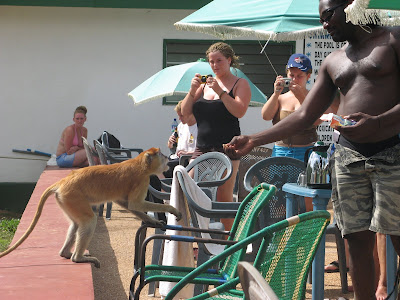
Trish and I completely missed two primate species that are common to Mole when we were here before: the patas monkey…

And the olive baboon…
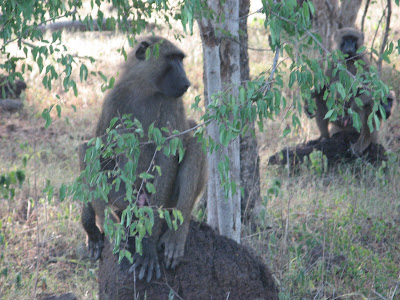
Both of which have been known to frequent the hotel veranda, where mostly obruni tourists lounge by the pool eating, drinking and smoking.
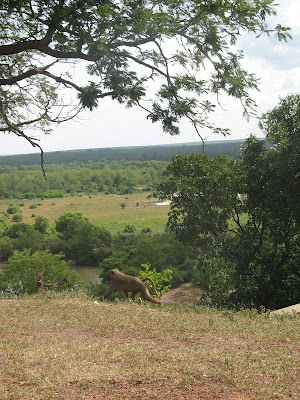
The morning of our departure I came walking along the veranda to watch the elephants take their morning bath when I heard a crashing in the bushes to my right, just off the plateau. Probably more baboons, I thought, but when I glanced over…

Yeah. I sat with this creature for almost an hour, watching him do what elephants do: eat. They consume 400 pounds of plant matter a day, I’m told. Eventually I went to get my camera but the batteries were almost dead, only enough juice for this final shot.
I bought more double-As before we got to Kintampo Falls, just off the southbound road home to Kumasi.

I stood at the base and took a pounding from the falling water that left me more refreshed than I have felt since sitting foot on African soil, five-and-a-half months ago. (G)
Northern Ghana
“You are in luck,” the young man on the side of the road told us when we stopped at a junction to ask directions to the crocodile lagoon. In his thick Ghanaian accent he explained that he was an “official agent” of the community-based ecotourism project that tended the crocodiles for tourists like us to come see. He told my friend Christophe, who was driving, that if he would kindly unlock the car’s rear door he’d hop in and personally guide us to the ponds. Oh, and there was also the “head office” that we must stop by first, to pay part of our fee…
“We just want to know if the ponds are this way,” Christophe told him. He confirmed the direction, and explained again the required protocol. Christophe didn’t unlock the door. “Maybe after we get a bite to eat we will come back,” he said, and we drove away.
A lie for a lie. That seems to be the rule in rural Ghana, where sparse tourist destinations garner tourist dollars that don’t get spread evenly enough to satisfy the locals. So young men lie to tourists, claiming some bogus official capacity in the hope that suckers will take the bait. There’ll be a fee for his services, of course, and when the actual attendants at places like the crocodile ponds see a group of gullible foreigners with a local “guide” they know the fleece is on, and quote double prices.
Can you blame them? Well, not really. But kinda. I can’t truly empathize, but I can understand the compulsion of impoverished Africans to try and make a few bucks off transient white folks like me. Man’s gotta eat. So no, I can’t blame them.
But yes, I can, because it’s a scam and dishonesty never sits well with me. I don’t think lying sits well with any of us; we all do it, some more than others, from time to time in life, and when we do we know we’re behaving dishonourably. Deceit feels wrong. I’d rather skip the posturing and deal with a beggar… but then I’d usually turn a beggar down, too. Some dishonour is more forgivable than others, I guess.
Anyway, without the help of the “official agent” we still managed to find the crocs and watched them crush live chickens (scroll down for photos) before turning back south to find more wildlife.

This was my second visit to Mole National Park. Too bad Trish couldn’t come for this one. When she and I were here in March we managed to find two elephants way off in the bush during a guided 4X4 tour. This time a herd of bulls took up almost permanent residence in the waterhole at the bottom of the main escarpment.

Christophe and I arrived in time for the afternoon safari to the waterhole. The elephants are very accustomed to human presence and didn’t seem to care in the least as a small group of us watched them bathe.

Trish and I completely missed two primate species that are common to Mole when we were here before: the patas monkey…

And the olive baboon…

Both of which have been known to frequent the hotel veranda, where mostly obruni tourists lounge by the pool eating, drinking and smoking.


The morning of our departure I came walking along the veranda to watch the elephants take their morning bath when I heard a crashing in the bushes to my right, just off the plateau. Probably more baboons, I thought, but when I glanced over…

Yeah. I sat with this creature for almost an hour, watching him do what elephants do: eat. They consume 400 pounds of plant matter a day, I’m told. Eventually I went to get my camera but the batteries were almost dead, only enough juice for this final shot.
I bought more double-As before we got to Kintampo Falls, just off the southbound road home to Kumasi.

I stood at the base and took a pounding from the falling water that left me more refreshed than I have felt since sitting foot on African soil, five-and-a-half months ago. (G)
Thursday, June 21, 2007
“The crocodiles are friendly”
June 18, 2007
Paga, Ghana.
Let me tell you something about crocodiles. We are not tame, despite what the dipshit tour guide told you. We are not “friendly.” We are pissed off. Wouldn’t you be?

Think of it: we’ve been living on this planet, perhaps in this very pond, since long before the ancestors of you fleshy pink primates climbed down from the trees and stood on their hind legs. We’re cousins with the dinosaurs, for God’s sake. We predate mammals by millennia.

You might think such elder status might engender some respect in you more junior species, but noooooo. You smartypantses got to be entertained. So you pay these local black-skinned brethren of yours to call us from our lagoon, so that we may suffer indignity for your viewing pleasure.

Don’t get me wrong, I’ll take the chicken. Nothing better than live meat, even if these are the scrawniest fowl I’ve ever snapped. If that pathetic squawking is making you uncomfortable I’ll be happy to end it, if you’d just tell the guide to…
SNAP!
Yeah. Mouthful of feathers. A little gamey, especially the legs, but succulent, succulent. Where was I?

Ah yes. The asshole griping my tail has reminded me: I’m working. It is my job to be on display like a circus freak or one of those slaves lying in a zoo for humans like you to ogle. Well, go ahead: take your photographs.
I’ll have you know, though, that I could lash around faster than you could blink and take this guy’s hand off at the elbow. So just think about that as you ponder his invitation to come and sit on me for a photo.
Sit on me. Can you believe it? And people do, they come pose on top of me. They know I won’t hurt them. Last croc from the lagoon who shredded a human wound up as a pair of boots with matching belt. No thanks. Although I must admit, every croc has his breaking point…

But I see you don’t have the guts. I also see that there will be no more tasty morsels on offer today. Very well. This is the part of the tour where I slither back into the lagoon, and you take off, get lost, go do… whatever it is you humans do when you’re not busy demeaning a miracle of planetary biology that has survived ice ages relatively unchanged.
It’s been fun. Next time bring more chicken. (G)
Paga, Ghana.
Let me tell you something about crocodiles. We are not tame, despite what the dipshit tour guide told you. We are not “friendly.” We are pissed off. Wouldn’t you be?

Think of it: we’ve been living on this planet, perhaps in this very pond, since long before the ancestors of you fleshy pink primates climbed down from the trees and stood on their hind legs. We’re cousins with the dinosaurs, for God’s sake. We predate mammals by millennia.

You might think such elder status might engender some respect in you more junior species, but noooooo. You smartypantses got to be entertained. So you pay these local black-skinned brethren of yours to call us from our lagoon, so that we may suffer indignity for your viewing pleasure.

Don’t get me wrong, I’ll take the chicken. Nothing better than live meat, even if these are the scrawniest fowl I’ve ever snapped. If that pathetic squawking is making you uncomfortable I’ll be happy to end it, if you’d just tell the guide to…
SNAP!
Yeah. Mouthful of feathers. A little gamey, especially the legs, but succulent, succulent. Where was I?

Ah yes. The asshole griping my tail has reminded me: I’m working. It is my job to be on display like a circus freak or one of those slaves lying in a zoo for humans like you to ogle. Well, go ahead: take your photographs.
I’ll have you know, though, that I could lash around faster than you could blink and take this guy’s hand off at the elbow. So just think about that as you ponder his invitation to come and sit on me for a photo.
Sit on me. Can you believe it? And people do, they come pose on top of me. They know I won’t hurt them. Last croc from the lagoon who shredded a human wound up as a pair of boots with matching belt. No thanks. Although I must admit, every croc has his breaking point…

But I see you don’t have the guts. I also see that there will be no more tasty morsels on offer today. Very well. This is the part of the tour where I slither back into the lagoon, and you take off, get lost, go do… whatever it is you humans do when you’re not busy demeaning a miracle of planetary biology that has survived ice ages relatively unchanged.
It’s been fun. Next time bring more chicken. (G)
Thursday, June 14, 2007
Images from the Beach
June 10
Green Turtle Lodge
Near Dixcove
Ghana
There was a storm at the beach but that didn't matter. There is something about the ocean that is without despair.

We went to find our way back to where it was our heads used to be. We went looking for solace and we found it.

I never used to think of the beach when I though of Africa, but now I always will. The people who built this place have a very good thing going.

There are turtles nesting nearby, somewhere, but we did not find them. We didn't even look. Why would we?

Two nights at the Green Turtle Lodge weren't nearly enough. We may go back, before we leave in the fall.

There were local people about who live there. I wonder if they know they live in paradise.
Green Turtle Lodge
Near Dixcove
Ghana
There was a storm at the beach but that didn't matter. There is something about the ocean that is without despair.

We went to find our way back to where it was our heads used to be. We went looking for solace and we found it.

I never used to think of the beach when I though of Africa, but now I always will. The people who built this place have a very good thing going.

There are turtles nesting nearby, somewhere, but we did not find them. We didn't even look. Why would we?

Two nights at the Green Turtle Lodge weren't nearly enough. We may go back, before we leave in the fall.

There were local people about who live there. I wonder if they know they live in paradise.
Subscribe to:
Posts (Atom)