August 16, 2007
Kumasi, Ghana
It would take too long to tell the story of Hirry properly in these digital pages. I’ve penned it elsewhere.
But the tale I’ve written about the young man I met in Osu lacks a conclusion that has only come with the revelations of time — and of my friend Christophe, who lived among Nigerians for six years and recognizes their scams.
Here is a synopsis of the salient details.
I met Hirry in Accra when he sat across from me and told me a story about buried treasure. He said he was a refugee from Sierra Leone whose father had been a great “rebel warrior” who accidentally blew himself up with his own grenade during the last civil war in the late 1990s. But before he died he buried a fortune in cash, blood diamonds and gold dust worth seven million British pounds sterling in a metal box on the outskirts of Freetown. Hirry knew where and he had the key; all he needed was $200 US to retrieve and bring it back to Ghana. If I’d help him, I’d get a cut.
Naturally that wasn’t going to happen, and I told him so. But I admit, the journalist in me was intrigued. If there was any merit to his story it would make a fantastic feature, the stuff careers are made of. I even considered accompanying him on a rather implausible overland journey from Accra through Cote d’Ivoire and Liberia — both of which have been torn apart by civil wars more recently than Sierra Leone— to help him dig up the treasure in the middle of the night and bring it back. I wouldn’t do it for the treasure, which I would not touch, but for the story, I explained. He said, Great. I said I’d think about it.
I suppose it’s salient to add that I was half drunk during that first two-hour conversation. Sitting at a plastic outdoor table on an Accra street, sun beating down, drinking beer and taking notes about Life, I didn’t tell Hirry to get lost when he approached me, but let him sit down and talk. I grilled him as I ordered more and more beer. At the end of it, I believed him.
When he phoned me a week later to say he’d got the $200 elsewhere and that he was going to Sierra Leone in a few days I still believed him, but was in no position to pick up and head to Freetown with someone I barely knew. Hirry seemed to expect my refusal. But he still wanted to meet me again, and as I happened to be passing through Accra I agreed.
This time he only wanted $100, to get back. Managed to wangle the first $200 from a girl he’d met. But he wanted much more than $100. Upon his return from Sierra Leone he wanted to come directly to Kumasi, where I’d told him I lived, to stash his loot. He wanted me to put the cash — he didn’t know how much — in my bank account and hold it for him. He wanted me to smuggle the diamonds and gold in my luggage when I returned to Canada. And he wanted me to help him get to Canada a few weeks later.
I explained why none of those things were going to happen, including the $100. He held his head and asked for whatever advice I could give.
At this point I still believed him. Not his entire story, but I believed that he believed his late father’s fortune existed and he wanted to go get it. But I wanted nothing to do with it, beyond write a story about it, and I told him as much.
Hirry guided me to the tro-tro park and before I got on the Kumasi shuttle he asked for some money so he wouldn’t have to spend any of his $200 on food over the weekend. I gave him $10. I felt I had to give him something. It was what I call a fuck-off payment, reserved for beggars and hustlers who are persistent when you don’t feel like arguing anymore. It’s just easier. Here’s some money; now fuck off.
During the drive I vowed never to give that guy another dime (or cedi). I reckoned it the $10 was worth it if he came through with a good story for me to write about. If not and it was all a scam — for this doubt did persist — then $10 was a small price to pay and I still had something to write about.
Hence this blog posting.
Hirry called me a week later. Said he’d been to Sierra Leone, retrieved what he went there for and had returned with a hired driver who he’d kept in the dark about the contents of the metal box. The driver wanted to talk to me. Wanted to know when I was coming back to Accra. Annoyed, I told him to call me some other time.
Which he did, two days later. The driver wanted to get paid and Hirry had told him I would pay. $200. I got Hirry on the line.
“Did you tell this man I would pay him two million cedis?”
“Yes.”
“Why did you do that, Hirry? You know it’s not true.”
“Please…”
“Please what?”
“Please, I beg you…”
“You can beg me all you want Hirry, I’m not giving anyone two million cedis.”
“You will get a percentage…”
That pissed me off.
“No I won’t Hirry, I don’t want a percentage. Why don’t you believe me?”
“What should I do? Tell me what you want me to do.”
“I want you to believe me when I tell you that you’re not getting any money out of me. If you want to meet me sometime to tell me about your journey, fine. Otherwise, I want you to stop calling me. Do you understand?”
“But what should I do?”
“It’s not my problem, Hirry. I’m hanging up. Goodbye.”
The driver called me back a minute later. I told him the same thing: forget about the money and stop calling.
“Is that clear?”
“Yes. Bye.”
That was the last I heard from either of them.
When Christophe heard this story he laughed immediately and said he was 100 per cent positive I’d been the target of a Nigerian scam.
Such hustles are amazingly cunning and complex, he told me, having been a target himself. The Nigerians know how to offer a thing you really, perhaps secretly, want, anticipate your reactions and read them as they come. Christophe thinks Hirry’s mistake was in gauging how much money I’d be willing to gamble.
But I say Hirry’s mistake was not believing that I wasn’t interested in the treasure, just the story. True, he managed to get $10 out of me. Worse than that, I actually worried that he might have been hurt for lying to the driver, broken legs or whatever. So I’m a dummy. But a cheap one, at least.
Trish was a little flabbergasted at my naivete. She was skeptical about the story from the moment I first told her about Hirry, but took me at my word when I said I believed him. She’s a little miffed that Christophe’s second-hand impression of the whole thing carries more weight with me than hers, for she told me herself many times that it sounded like a scam. But he knows more about this culture and all its intricacies, including Nigerian hustles, than both of us together. That’s why I’m inclined to believe him. But really, we’ll never know.
One thing is certain, however: the next guy coming at me in Osu with a fantastic story involving minimum risk for incredible payoff, I’m going to try out a phrase of Nigerian pidgin English that Christophe taught me that means, loosely, ‘Why are you bullshitting me?’ (G)
Friday, August 17, 2007

Wednesday, August 15, 2007
Evasion
August 13, 2007
Kumasi, Ghana
Final Kumasi transition complete and we have switched residences again, from peaceful quiet Tech campus back to noisy Asokwa. It’s not the cries of approval or dismay from tele-football watchers that disturb us, or the calls for ‘BISMARK!’ who still works at our old residence, Silver Ring, down the road from where we are now. Now, it’s automobile traffic passing by on the busy road outside our windows and early morning joggers waking us up weekends at 5:30 a.m. as they storm past in a pack, banging drums and chanting slogans, some of which are tributes meant for Allah (on Saturday) and Jesus (on Sunday). WTF?
But enough of that. Today when I went back to Tech to retrieve daddy pomco (my bicycle) which remained locked in Virginie’s foyer, I met some children on my way out who recognized me and wanted to become my “friend.”
Here’s something for an enterprising journalist: figure out why so many Ghanaians want the foreign addresses and phone numbers of the oburonis that they meet. For some, no doubt, they want out of this place and a chance for a better life in whatever country I come from, which, they are convinced, must be akin to Paradise. Explaining that suffering and poverty exist everywhere in the world and that life in Canada is hard for many, especially immigrants, is a futile pursuit. Besides, I can’t blame the Ghanaians for wanting to leave. I want out of here, too.
But half the population can’t read or write, so what do they want my address for? And what are the chances a seven-year-old is going to take the trouble of staying in touch? I’ve given my contact info — or, rather, my parents’ — out on more than one occasion, until it occurred to me that the kids I’m pretending I’m going to stay in touch with might be using the digits for a different, fouler purpose, like selling my information for a few cedis to a Nigerian con artist who forges passports. Or something. One common scam I’ve heard about is to call the parents of oburoni volunteers and tell them an accident has occurred and to send money for the hospital bills right away (Mom, Dad, if you get such a call don’t you believe it). Anyway, I don’t do it anymore. Give out the info, that is.
Instead I evade. Like when two kids walked up to me on the street down in Asokwa, outside the Jesus Café, all smiles and said, “Oburoni, give me thousand!” It’s a common enough encounter that Trish and I have both expounded in these pages. The days of wondering if this is a cultural propriety — something that Ghanaians do among themselves, share money, and therefore a sign of welcome and acceptance — or benign yet unseemly racism — being targeted because my skin is white and I must therefore have money to spread around as I walk through African streets — are over. We’re only here for a short while longer and I no longer care what ‘the right thing to do’ might be. So I smile at the kids who are smiling at me, shake their hands and tell them I’m not going to give them a thousand cedis but that I wish them well. We go our separate ways, still smiling.
Or when another pack of kids, the ‘friends’ outside Virginie’s place, ask me how I’m doing and what’s my name and I stop to talk. I met Florence, Lucy, David and Daniel this way. Florence recognized me from walking by her mother’s fruit stand just outside the Bomso gate at Tech campus. Such kids are always super keen to practice their English.
“HOW ARE YOU?”
“I am fine. And how are you?”
“I AM ALSO FINE. WHAT IS YOUR NAME?”
My name is Graeme. What is your name?
MY NAME IS FLORENCE!
Nice to meet you.
I AM LUCY!
Nice to meet you, too.
(Another kid, a boy, pipes up.)
I WANT TO BE YOUR FRIEND.
That’s very nice. What is your name?
YES, WE WANT TO BE YOUR FRIEND.
I see. What are your names? I know their names (gesturing to the girls) but what are your names?
I AM DAVID!
Hello David.
AND I AM DANIEL!
Greetings, Daniel. Nice to meet you all.
PLEASE, WHAT IS YOUR ADDRESS?
(This is where the evasion begins.)
I live over there. (Pointing)
(Pause.)
CAN I HAVE YOUR NUMBER?
It is the second house. Number two.
(Pause.)
CAN I HAVE YOUR NUMBER?
You mean my phone number?
YES, YOUR PHONE NUMBER.
You can find me at the second house over there. Or we can talk whenever we meet in the street.
(Pause.)
I WANT TO HAVE YOU FOR A FRIEND.
YES, WE WANT TO HAVE YOU FOR A FRIEND.
Well that is very nice. Whenever we meet here in the street, we can be friends. I would like that.
(Pause. Consternation. Their questions have been answered, their English vocabulary almost used up.)
OKAY. BYE BYE!
Yes, bye bye, have a good day.
YOU ALSO, HAVE A GOOD DAY!!
And we’re all still smiling. I hear them chatter about oburoni as I walk away. I don’t bother to mention that I won’t be coming back.
Is this wrong, to mislead children and speak to them falsely so that they will stop asking for things, like money or salvation, that I am unable or unwilling to give? Possibly. Probably. But none of that changes their situation, or mine. It’s not in my power, nor my inclination, to change things for the people I meet. I came here to exchange ideas, learn some stuff, do a little writing. Locals, and not only the kids, often expect some material gain from my acquaintance. I can’t blame them. But I don’t bother explaining that I’m never going to be what they want me to be. (G)
Kumasi, Ghana
Final Kumasi transition complete and we have switched residences again, from peaceful quiet Tech campus back to noisy Asokwa. It’s not the cries of approval or dismay from tele-football watchers that disturb us, or the calls for ‘BISMARK!’ who still works at our old residence, Silver Ring, down the road from where we are now. Now, it’s automobile traffic passing by on the busy road outside our windows and early morning joggers waking us up weekends at 5:30 a.m. as they storm past in a pack, banging drums and chanting slogans, some of which are tributes meant for Allah (on Saturday) and Jesus (on Sunday). WTF?
But enough of that. Today when I went back to Tech to retrieve daddy pomco (my bicycle) which remained locked in Virginie’s foyer, I met some children on my way out who recognized me and wanted to become my “friend.”
Here’s something for an enterprising journalist: figure out why so many Ghanaians want the foreign addresses and phone numbers of the oburonis that they meet. For some, no doubt, they want out of this place and a chance for a better life in whatever country I come from, which, they are convinced, must be akin to Paradise. Explaining that suffering and poverty exist everywhere in the world and that life in Canada is hard for many, especially immigrants, is a futile pursuit. Besides, I can’t blame the Ghanaians for wanting to leave. I want out of here, too.
But half the population can’t read or write, so what do they want my address for? And what are the chances a seven-year-old is going to take the trouble of staying in touch? I’ve given my contact info — or, rather, my parents’ — out on more than one occasion, until it occurred to me that the kids I’m pretending I’m going to stay in touch with might be using the digits for a different, fouler purpose, like selling my information for a few cedis to a Nigerian con artist who forges passports. Or something. One common scam I’ve heard about is to call the parents of oburoni volunteers and tell them an accident has occurred and to send money for the hospital bills right away (Mom, Dad, if you get such a call don’t you believe it). Anyway, I don’t do it anymore. Give out the info, that is.
Instead I evade. Like when two kids walked up to me on the street down in Asokwa, outside the Jesus Café, all smiles and said, “Oburoni, give me thousand!” It’s a common enough encounter that Trish and I have both expounded in these pages. The days of wondering if this is a cultural propriety — something that Ghanaians do among themselves, share money, and therefore a sign of welcome and acceptance — or benign yet unseemly racism — being targeted because my skin is white and I must therefore have money to spread around as I walk through African streets — are over. We’re only here for a short while longer and I no longer care what ‘the right thing to do’ might be. So I smile at the kids who are smiling at me, shake their hands and tell them I’m not going to give them a thousand cedis but that I wish them well. We go our separate ways, still smiling.
Or when another pack of kids, the ‘friends’ outside Virginie’s place, ask me how I’m doing and what’s my name and I stop to talk. I met Florence, Lucy, David and Daniel this way. Florence recognized me from walking by her mother’s fruit stand just outside the Bomso gate at Tech campus. Such kids are always super keen to practice their English.
“HOW ARE YOU?”
“I am fine. And how are you?”
“I AM ALSO FINE. WHAT IS YOUR NAME?”
My name is Graeme. What is your name?
MY NAME IS FLORENCE!
Nice to meet you.
I AM LUCY!
Nice to meet you, too.
(Another kid, a boy, pipes up.)
I WANT TO BE YOUR FRIEND.
That’s very nice. What is your name?
YES, WE WANT TO BE YOUR FRIEND.
I see. What are your names? I know their names (gesturing to the girls) but what are your names?
I AM DAVID!
Hello David.
AND I AM DANIEL!
Greetings, Daniel. Nice to meet you all.
PLEASE, WHAT IS YOUR ADDRESS?
(This is where the evasion begins.)
I live over there. (Pointing)
(Pause.)
CAN I HAVE YOUR NUMBER?
It is the second house. Number two.
(Pause.)
CAN I HAVE YOUR NUMBER?
You mean my phone number?
YES, YOUR PHONE NUMBER.
You can find me at the second house over there. Or we can talk whenever we meet in the street.
(Pause.)
I WANT TO HAVE YOU FOR A FRIEND.
YES, WE WANT TO HAVE YOU FOR A FRIEND.
Well that is very nice. Whenever we meet here in the street, we can be friends. I would like that.
(Pause. Consternation. Their questions have been answered, their English vocabulary almost used up.)
OKAY. BYE BYE!
Yes, bye bye, have a good day.
YOU ALSO, HAVE A GOOD DAY!!
And we’re all still smiling. I hear them chatter about oburoni as I walk away. I don’t bother to mention that I won’t be coming back.
Is this wrong, to mislead children and speak to them falsely so that they will stop asking for things, like money or salvation, that I am unable or unwilling to give? Possibly. Probably. But none of that changes their situation, or mine. It’s not in my power, nor my inclination, to change things for the people I meet. I came here to exchange ideas, learn some stuff, do a little writing. Locals, and not only the kids, often expect some material gain from my acquaintance. I can’t blame them. But I don’t bother explaining that I’m never going to be what they want me to be. (G)
Thursday, August 9, 2007
Café Buroburo
August 9, 2007
Kumasi, Ghana
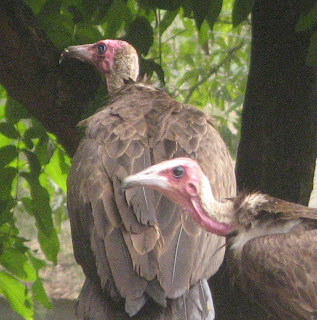
The vultures came again today. Mad crazy mean-looking birds with pink-red streaks on their faces, like scarlet fever. Long hooked beaks. Feasting on the mound of fetid, rotting garbage that always overflows mid-week from the concrete dumpster up the road from where we live. A scavenger’s buffet for beast and bacteria.

There doesn’t seem to be any pecking order among the various species who feed each day at the dumpster. The vultures are huge raptors and by far the most menacing, though only in appearance — they are actually quite timid and easily startled by a sudden jab-step from a passing human, ha ha. And they don’t bother the magpies, much smaller, who perch among them on the concrete rim of the dumpster and take their share of morsels. It’s all very civilized; there’s plenty for everyone.

On the ground, chickens: roosters and hens. Doing their cluck walk, heads bobbing that fowl way, pecking at the outskirts of the feast where smeared food wrappers and soaked bits of torn plastic have sifted from the frenzy. They’ll walk right next to the bin but can’t get up top like the others, for they are flightless and thus condemned to scraps.

Nobody minds the dogs; wretched curs missing tufts of hair from their coats where fleshy sores peek through, but living the good life rooting about the dumpster’s messy overflow. Long-tongued bitches with ravaged teats hanging low to the same asphalt they lick. Barely take notice of the chickens that would be chased in an instant by other dogs I know, back home. Here, everyone feeds at the same trough.

Except the kittens. There’s another concrete dumpster the same size up the road a ways, maybe 100 metres. Usually there’s much less in it. But there’s plenty that’s edible, for sure, yet for some reason the dogs and birds don’t dine there. Felines only. There are two of them, and unlike the other creatures feeding on Buroburo Road they are adorable.
However, they are just as filthy and constantly bathing when they are not scrounging, perched on the dumpster's edge, doing the tongue bath. They’d make a fine snack for the vultures, if the human caretakers of the Kwame Nkrumah University of Science and Technology campus ever get around to keeping the street clear of tasty trash.

I don’t know if the cats have been excluded from the grand feast, or if everyone has agreed out of respect that felines should have their own restaurant. I’ll get Trish to ask them. But they can’t stay with us. (G)
Kumasi, Ghana

The vultures came again today. Mad crazy mean-looking birds with pink-red streaks on their faces, like scarlet fever. Long hooked beaks. Feasting on the mound of fetid, rotting garbage that always overflows mid-week from the concrete dumpster up the road from where we live. A scavenger’s buffet for beast and bacteria.

There doesn’t seem to be any pecking order among the various species who feed each day at the dumpster. The vultures are huge raptors and by far the most menacing, though only in appearance — they are actually quite timid and easily startled by a sudden jab-step from a passing human, ha ha. And they don’t bother the magpies, much smaller, who perch among them on the concrete rim of the dumpster and take their share of morsels. It’s all very civilized; there’s plenty for everyone.

On the ground, chickens: roosters and hens. Doing their cluck walk, heads bobbing that fowl way, pecking at the outskirts of the feast where smeared food wrappers and soaked bits of torn plastic have sifted from the frenzy. They’ll walk right next to the bin but can’t get up top like the others, for they are flightless and thus condemned to scraps.

Nobody minds the dogs; wretched curs missing tufts of hair from their coats where fleshy sores peek through, but living the good life rooting about the dumpster’s messy overflow. Long-tongued bitches with ravaged teats hanging low to the same asphalt they lick. Barely take notice of the chickens that would be chased in an instant by other dogs I know, back home. Here, everyone feeds at the same trough.

Except the kittens. There’s another concrete dumpster the same size up the road a ways, maybe 100 metres. Usually there’s much less in it. But there’s plenty that’s edible, for sure, yet for some reason the dogs and birds don’t dine there. Felines only. There are two of them, and unlike the other creatures feeding on Buroburo Road they are adorable.
However, they are just as filthy and constantly bathing when they are not scrounging, perched on the dumpster's edge, doing the tongue bath. They’d make a fine snack for the vultures, if the human caretakers of the Kwame Nkrumah University of Science and Technology campus ever get around to keeping the street clear of tasty trash.

I don’t know if the cats have been excluded from the grand feast, or if everyone has agreed out of respect that felines should have their own restaurant. I’ll get Trish to ask them. But they can’t stay with us. (G)
Wednesday, August 8, 2007
Umm, sometimes God is not the answer
August 8, 2007
Kumasi, Ghana
I can still remember folding my hands,fingers pointed in the shape of a steeple singing, “I am the church, you are the church, we are the church together,” before a group of 5-year-olds. Every Sunday morning we would gather in the basement of the United Church. I, seeking a connection to something spiritual and they, dressed in their Sunday best coming at the behest of their parents, had fun on those Sunday mornings.
Now, nearly 15 years later, I recollect my church experience with fondness. In fact, in conversation with Ghanaians, who are well known for their church attendance, I’ll often use my Sunday school experience as a buttress to my criticism of how the church suffocates and controls Ghanaian life. "See I was a Sunday school teacher, really, I’m not a heathen," as I growl under my breath at the Christian rock station from Iowa blaring on the taxi’s radio.
I respect those who find time to connect to God, their God, to spirituality. I lose respect when Jesus is marketed like a rock icon, a lover and the answer to every question. Twelve-day spiritual retreats, nightly vigils of intense praying and healing sessions are common in Kumasi. Prayer camps, places where those who believe prayer can heal their ailments, are plentiful. While loud speakers deliver the word of God, people deemed mentally ill or “mad” are kept in chains nearby.
“God has given me a gift, the gift operates within me, so when you see the person the holy spirit tells you what is happening,” said a pastor during a recent interview about why he sees fit to chain a 10-year-old mentally handicapped girl. Without chains, he insists, I couldn’t pray for such people. Or control them, perhaps?
There’s an expression in Ghana that goes: if you want to be rich, become a pastor or start an NGO. During my time in Ghana I’ve met many a pastor, and have sat through a service where I watched millions of cedis or hundreds of Canadian dollars be offered up as an offering to God. The more money the more applause; money it seems can make ordinary men pastors and institutions of NGOs.
Now don’t get me wrong. Faith is a good thing. And granted people who struggle to feed themselves, their families and watch as relatives die need faith, arguably we all do. It’s the blindly faithful that I question.
"God willing" is the answer to everything. “God willing, we’ll find money to build a new prison,” said a Ghanaian born pastor from the UK. “God willing this girl will find money for school,” said the head of an NGO that rescues trafficked children. "God willing, I’ll be here tomorrow,” says the host of a popular radio morning show. God willing Ghanaians will wake up and see how God is being sold to them and the cost of something more precious, the truth.
Living here has further made me question my own spirituality, a pursuit or a belief that I believe is lifelong and evolutionary. Am thinking about reading the Bible too, not because of the armies of Christians who have tried to tell me about its healing powers, but rather to fortify my defence the next time someone uses the Bible to defend their views on the subjugation of women or the evil of homosexuality or how there’s only one true God. (T)
Kumasi, Ghana
I can still remember folding my hands,fingers pointed in the shape of a steeple singing, “I am the church, you are the church, we are the church together,” before a group of 5-year-olds. Every Sunday morning we would gather in the basement of the United Church. I, seeking a connection to something spiritual and they, dressed in their Sunday best coming at the behest of their parents, had fun on those Sunday mornings.
Now, nearly 15 years later, I recollect my church experience with fondness. In fact, in conversation with Ghanaians, who are well known for their church attendance, I’ll often use my Sunday school experience as a buttress to my criticism of how the church suffocates and controls Ghanaian life. "See I was a Sunday school teacher, really, I’m not a heathen," as I growl under my breath at the Christian rock station from Iowa blaring on the taxi’s radio.
I respect those who find time to connect to God, their God, to spirituality. I lose respect when Jesus is marketed like a rock icon, a lover and the answer to every question. Twelve-day spiritual retreats, nightly vigils of intense praying and healing sessions are common in Kumasi. Prayer camps, places where those who believe prayer can heal their ailments, are plentiful. While loud speakers deliver the word of God, people deemed mentally ill or “mad” are kept in chains nearby.
“God has given me a gift, the gift operates within me, so when you see the person the holy spirit tells you what is happening,” said a pastor during a recent interview about why he sees fit to chain a 10-year-old mentally handicapped girl. Without chains, he insists, I couldn’t pray for such people. Or control them, perhaps?
There’s an expression in Ghana that goes: if you want to be rich, become a pastor or start an NGO. During my time in Ghana I’ve met many a pastor, and have sat through a service where I watched millions of cedis or hundreds of Canadian dollars be offered up as an offering to God. The more money the more applause; money it seems can make ordinary men pastors and institutions of NGOs.
Now don’t get me wrong. Faith is a good thing. And granted people who struggle to feed themselves, their families and watch as relatives die need faith, arguably we all do. It’s the blindly faithful that I question.
"God willing" is the answer to everything. “God willing, we’ll find money to build a new prison,” said a Ghanaian born pastor from the UK. “God willing this girl will find money for school,” said the head of an NGO that rescues trafficked children. "God willing, I’ll be here tomorrow,” says the host of a popular radio morning show. God willing Ghanaians will wake up and see how God is being sold to them and the cost of something more precious, the truth.
Living here has further made me question my own spirituality, a pursuit or a belief that I believe is lifelong and evolutionary. Am thinking about reading the Bible too, not because of the armies of Christians who have tried to tell me about its healing powers, but rather to fortify my defence the next time someone uses the Bible to defend their views on the subjugation of women or the evil of homosexuality or how there’s only one true God. (T)
Office Space
August 3, 2007
Kumasi, Ghana
The British Council was like my office. We discovered it our very first day in Kumasi but I avoided the place for a month because I didn’t want to be like all the other obrunis visiting this city. What a stupid impulse that is, to try not to be like other white people traveling in Africa. All of us indulge in this avoidance of our brethren from time to time, some more frequently and adamantly than others, but nothing’s going to change the fact that white people stand out here and obviously do not belong, no matter where they go or what they do. True, we didn’t come to Ghana to experience an isolated obruni culture, but we will never be anything but obruni and it’s foolish to avoid certain places because other whities flock to them. But I digress.

Back in March I bought a six-month membership to the British Council. It was like an oasis of order in an ocean of chaos, although that’s not really an apt metaphor: Adum, the central hill of Kumasi on which the council and all the major banks are perched, is the least crazy place in town. Still, to get there I had to traverse Asokwa, in a packed tro-tro or on foot or cycle, amid “obruni!” catcalls from children, through clogged traffic lined with hawkers and across a trash filled gully where the goats were congregated, sometimes brushing the outskirts of Kejetia or Central markets that were brimming with the morning rush. And that was all in equatorial heat that increasingly sweltered even before 9 a.m.

Walking into the council provoked two startling contrasts, one of climate, the other of sound. I could feel my capillaries contract so abruptly from the powerful air-conditioning that I would get an immediate chill inside the door. And the drone of automobiles and cries from street sellers would be replaced by quiet BBC reportage, ever-present on the screen of an enormous TV in the corner of the room. Otherwise the place was quiet as a library, which in part it was.
A sofa and chair sat next to a Nescafe machine across from the television. On the other side there were three administration desks, a water cooler, a photocopy machine and a lavatory that was, hands down, the best public place in Kumasi to take a dump. Throughout the rest of the U-shaped building books and videotapes lined the walls, except for where the 12 computer terminals were installed, offering the best Internet connection to be found in Kumasi.
Tables and chairs at either end of the main room always filled by noon. It’s true that obrunis frequented the place but the majority of its patrons were Ghanaians taking advantage of literature and technology, of modernity. It was a wonderful place to work, to do research or to write or just to watch the news in peace and quiet so sacrosanct that people took their cell phone calls outside.
The powers that be have closed the council to do a month-long comprehensive inventory. It reopens September 3. But by that time, if anything goes according to plan, we will be gone from Kumasi.
To reveal anything more of our Grand Scheme would be telling tales out of school, so I won’t. But chances are I won’t be going back into the council again, and I miss it already. (G)
Kumasi, Ghana
The British Council was like my office. We discovered it our very first day in Kumasi but I avoided the place for a month because I didn’t want to be like all the other obrunis visiting this city. What a stupid impulse that is, to try not to be like other white people traveling in Africa. All of us indulge in this avoidance of our brethren from time to time, some more frequently and adamantly than others, but nothing’s going to change the fact that white people stand out here and obviously do not belong, no matter where they go or what they do. True, we didn’t come to Ghana to experience an isolated obruni culture, but we will never be anything but obruni and it’s foolish to avoid certain places because other whities flock to them. But I digress.

Back in March I bought a six-month membership to the British Council. It was like an oasis of order in an ocean of chaos, although that’s not really an apt metaphor: Adum, the central hill of Kumasi on which the council and all the major banks are perched, is the least crazy place in town. Still, to get there I had to traverse Asokwa, in a packed tro-tro or on foot or cycle, amid “obruni!” catcalls from children, through clogged traffic lined with hawkers and across a trash filled gully where the goats were congregated, sometimes brushing the outskirts of Kejetia or Central markets that were brimming with the morning rush. And that was all in equatorial heat that increasingly sweltered even before 9 a.m.

Walking into the council provoked two startling contrasts, one of climate, the other of sound. I could feel my capillaries contract so abruptly from the powerful air-conditioning that I would get an immediate chill inside the door. And the drone of automobiles and cries from street sellers would be replaced by quiet BBC reportage, ever-present on the screen of an enormous TV in the corner of the room. Otherwise the place was quiet as a library, which in part it was.
A sofa and chair sat next to a Nescafe machine across from the television. On the other side there were three administration desks, a water cooler, a photocopy machine and a lavatory that was, hands down, the best public place in Kumasi to take a dump. Throughout the rest of the U-shaped building books and videotapes lined the walls, except for where the 12 computer terminals were installed, offering the best Internet connection to be found in Kumasi.
Tables and chairs at either end of the main room always filled by noon. It’s true that obrunis frequented the place but the majority of its patrons were Ghanaians taking advantage of literature and technology, of modernity. It was a wonderful place to work, to do research or to write or just to watch the news in peace and quiet so sacrosanct that people took their cell phone calls outside.
The powers that be have closed the council to do a month-long comprehensive inventory. It reopens September 3. But by that time, if anything goes according to plan, we will be gone from Kumasi.
To reveal anything more of our Grand Scheme would be telling tales out of school, so I won’t. But chances are I won’t be going back into the council again, and I miss it already. (G)
Wednesday, August 1, 2007
Can I not find a tennis racquet anywhere in this cornucopia of consumer merchandise?
July 27, 2007
Kejetia Market
Kumasi, Ghana
Kejetia. From where does this name come? I don’t know what Kumasi’s main market, rumuored to be one of the largest in West Africa, is named for but that’s not important. What is important is that I need a tennis racquet, and can’t seem to find one.
There are courts out at the university, you see, where we are staying for only another two weeks. Of course, I could go out there any time to play until we shove off completely from this town. Wouldn’t you know it, the only tennis racquets I’ve been able to find were in a specialty shop, and they were quality items — Head, Penn, etc. — worth the price tag of 1.8 million cedis, or roughly$180 USD. That’s what you’d pay for them out West, and here, it seems.
But no, I’m not dropping that kind of cash on a tennis racquet I may or may not use more than once while I’m in West Africa. Therefore, unto Kejetia.
You’d think you’d find one in here, you really would. Long, tight paths snake their way through this inner-city shantytown of wooden frames and currogated tin roofs that is home to any consumer good you could buy or imagine. Not high end stuff, no automobiles or Gucci sunglasses (although plenty of knockoffs). But any one thing — tape, a stuffed teddy bear, pencil crayons — you can find in Kejetia. It’s like the African concept of WalMart, without the corporate infrastructure but with mud floors clogged with garbage and stalls where they butcher raw meat.
To get here you walk from Adum where the banks are downhill to the heart of Kumasi where snarled roads meet in a roundabout. Across the street is the entranceway, which is always thronged with crushing humanity walking to and fro, mostly market women carrying merchandise in great metal basins atop their heads. Take a deep breath and step into the tide. From this moment onward, you will not stop moving.
Pick a lane, there are a few to choose from. That way will take you through mechanical parts. This way’s the way to ladies hosiery. If it’s groceries you want work your way to the middle. What? A tennis racquet… go left here, then ask somebody.
Down this small pathway between the stalls in the line among mostly female Africans you keep moving, keep moving. Do not stop. To stop is to clog the system — pressure builds behind you as you bend to tie your shoe. There’s only really enough room on the path between stalls for one human to walk comfortably but true to form the Africans make things bigger than they are, so there are two lines of opposing human traffic and you are stopping one of them, so move.
The ladies at the stalls call a greeting as you pass; they’re not used to seeing a white man in here, and what’s he doing in hosiery? No time to stop and chat though, the girl behind you will bash you with her metal basin if you pause. It’s a miracle she hasn’t already, but her kind are adept with their headgear. Years of practice.
Tennis racquet? You mean like this? No, it’s for badminton, right… what’s the difference? Bigger? Oh, you mean a tennis racquet…. No, for that you’ve got to go to town. You already came from town? Well, you’ll have to go back and look again.
Just head towards the chili powder and take a right. When you come to a building wall follow it until you can squeeze through an alley to the street. Ask for a guy named Kofi, my brother; he’ll know about tennis. (G)
Kejetia Market
Kumasi, Ghana
Kejetia. From where does this name come? I don’t know what Kumasi’s main market, rumuored to be one of the largest in West Africa, is named for but that’s not important. What is important is that I need a tennis racquet, and can’t seem to find one.
There are courts out at the university, you see, where we are staying for only another two weeks. Of course, I could go out there any time to play until we shove off completely from this town. Wouldn’t you know it, the only tennis racquets I’ve been able to find were in a specialty shop, and they were quality items — Head, Penn, etc. — worth the price tag of 1.8 million cedis, or roughly$180 USD. That’s what you’d pay for them out West, and here, it seems.
But no, I’m not dropping that kind of cash on a tennis racquet I may or may not use more than once while I’m in West Africa. Therefore, unto Kejetia.
You’d think you’d find one in here, you really would. Long, tight paths snake their way through this inner-city shantytown of wooden frames and currogated tin roofs that is home to any consumer good you could buy or imagine. Not high end stuff, no automobiles or Gucci sunglasses (although plenty of knockoffs). But any one thing — tape, a stuffed teddy bear, pencil crayons — you can find in Kejetia. It’s like the African concept of WalMart, without the corporate infrastructure but with mud floors clogged with garbage and stalls where they butcher raw meat.
To get here you walk from Adum where the banks are downhill to the heart of Kumasi where snarled roads meet in a roundabout. Across the street is the entranceway, which is always thronged with crushing humanity walking to and fro, mostly market women carrying merchandise in great metal basins atop their heads. Take a deep breath and step into the tide. From this moment onward, you will not stop moving.
Pick a lane, there are a few to choose from. That way will take you through mechanical parts. This way’s the way to ladies hosiery. If it’s groceries you want work your way to the middle. What? A tennis racquet… go left here, then ask somebody.
Down this small pathway between the stalls in the line among mostly female Africans you keep moving, keep moving. Do not stop. To stop is to clog the system — pressure builds behind you as you bend to tie your shoe. There’s only really enough room on the path between stalls for one human to walk comfortably but true to form the Africans make things bigger than they are, so there are two lines of opposing human traffic and you are stopping one of them, so move.
The ladies at the stalls call a greeting as you pass; they’re not used to seeing a white man in here, and what’s he doing in hosiery? No time to stop and chat though, the girl behind you will bash you with her metal basin if you pause. It’s a miracle she hasn’t already, but her kind are adept with their headgear. Years of practice.
Tennis racquet? You mean like this? No, it’s for badminton, right… what’s the difference? Bigger? Oh, you mean a tennis racquet…. No, for that you’ve got to go to town. You already came from town? Well, you’ll have to go back and look again.
Just head towards the chili powder and take a right. When you come to a building wall follow it until you can squeeze through an alley to the street. Ask for a guy named Kofi, my brother; he’ll know about tennis. (G)
Monday, July 23, 2007
Hospitality, Ghana style
July 17-19, 2007
Obuasi, Ghana
Like the shy smile that escapes from the stoic expression of a Ghanaian security guard or an old woman selling snails in the market, Ghanaian hospitality is unexpected. Unexpected, but once extended ultimately warm and genuine.
Take for example a recent trip to Obuasi, a gold mining town not far from Kumasi. While there a colleague and I were warmly welcomed. We were invited into homes, well fed, watered and encouraged to relax with a Star beer in hand while listening to wall-shaking loud Christian rock music. Women cooked our meals outside over charcoal pits; another woman, the wife of Bernard who took time off from his job as news editor of a local radio station to guide us, also spent hours preparing food for the guests from out of town.

Always, I ate with the men, secretly wanting to be let into the world of the women; cooking, tending to the children, knowing how they make so much from so little. A handshake, a modest bow was my only contact. After our meal made over the charcoal pit I met the women. The electricity suddenly cut out in an all-to-common blackout and we stood talking, laughing in the dark. Then the rains came, swift and unexpected. One woman handed me her umbrella; another guided me out the door.
Later that evening we were offered a ride by a man who had room in his car. The next day we drank pito, a fermented drink from palm trees with the galamsayers (illegal miners) in the bush. They too were hospitable, warm, welcoming, despite the job we were both there to do, which was tell their unfortunate story.
And then there was the legal mine worker at Anglogold Ashanti who insisted he stop the car so he could harvest some corn for us from the company’s property. Or the women we met while on a father visit with Bernard. He was there to see the child he had with another woman. We left nothing bur rather walked away with meat pies for our trip back to Kumasi.
Ghanaians are quick to socialize and to extend an offer to socialize with them by offering the best chair in the house (even if it means it comes from a bedroom at the back of the house), an overturned bowl or a stool to sit on.
Unexpected and greatly appreciated. Makes me wonder what I am giving in return. (T)
Obuasi, Ghana
Like the shy smile that escapes from the stoic expression of a Ghanaian security guard or an old woman selling snails in the market, Ghanaian hospitality is unexpected. Unexpected, but once extended ultimately warm and genuine.
Take for example a recent trip to Obuasi, a gold mining town not far from Kumasi. While there a colleague and I were warmly welcomed. We were invited into homes, well fed, watered and encouraged to relax with a Star beer in hand while listening to wall-shaking loud Christian rock music. Women cooked our meals outside over charcoal pits; another woman, the wife of Bernard who took time off from his job as news editor of a local radio station to guide us, also spent hours preparing food for the guests from out of town.

Always, I ate with the men, secretly wanting to be let into the world of the women; cooking, tending to the children, knowing how they make so much from so little. A handshake, a modest bow was my only contact. After our meal made over the charcoal pit I met the women. The electricity suddenly cut out in an all-to-common blackout and we stood talking, laughing in the dark. Then the rains came, swift and unexpected. One woman handed me her umbrella; another guided me out the door.
Later that evening we were offered a ride by a man who had room in his car. The next day we drank pito, a fermented drink from palm trees with the galamsayers (illegal miners) in the bush. They too were hospitable, warm, welcoming, despite the job we were both there to do, which was tell their unfortunate story.
And then there was the legal mine worker at Anglogold Ashanti who insisted he stop the car so he could harvest some corn for us from the company’s property. Or the women we met while on a father visit with Bernard. He was there to see the child he had with another woman. We left nothing bur rather walked away with meat pies for our trip back to Kumasi.
Ghanaians are quick to socialize and to extend an offer to socialize with them by offering the best chair in the house (even if it means it comes from a bedroom at the back of the house), an overturned bowl or a stool to sit on.
Unexpected and greatly appreciated. Makes me wonder what I am giving in return. (T)
Subscribe to:
Posts (Atom)